Branchlings and a flying fox

A Week or Two in the Manawatū

February 2026

In the past, the Manawatū has mostly been drive-through or fly-over country for us – flat, apparently featureless, and home to Palmerston North (famous for making anywhere else look attractive) and Bulls, the pun capital of New Zealand (Coffee on the Moove and toilets labelled Relieve-a-bull).

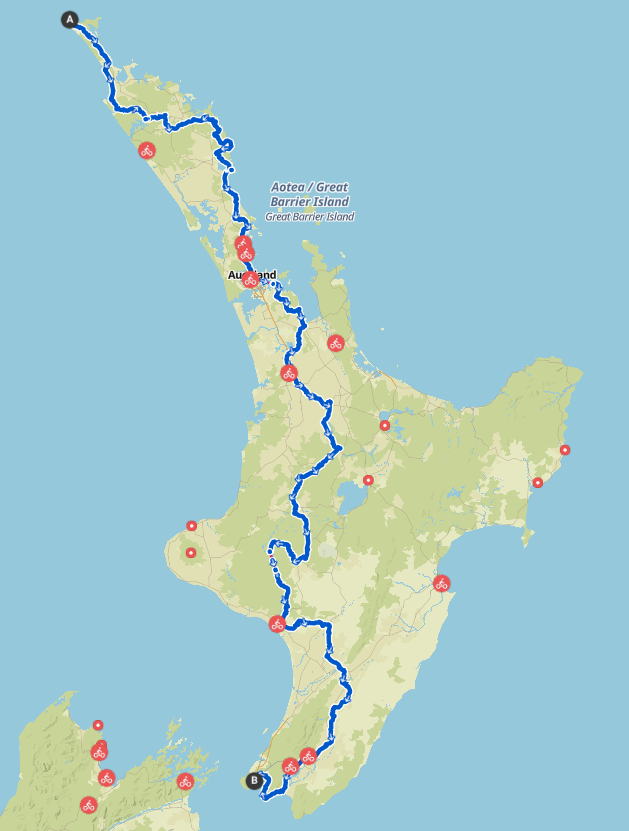
When we biked through on our Tour Aotearoa ride in the summer of 23/24 the route took us on remote tracks through untouched parts of the Whanganui National Park, and down into the very charming river city of Whanganui. The next section was northern Manawatu and the Eastern Ruahines which are neither flat nor boring, however for logistical reasons at the time we missed out a part of that route. We therefore decided this summer, while travelling in the Egg, our faithful motorhome,  to do an overnighter to plug that gap.


Ashhurst

Once renowned for its concentration of fundamentalist churches, Ashhurst is actually a pleasant small town with an excellent council-run campground. It has free, clean hot showers and powered sites at $10 per head per night – a perfect place to leave the Egg overnight (especially with buggered solar). I’ll always remember it for the branchling tūī.

I learnt that word after sharing a photo and video of a baby tui with the Birds of NZ Facebook group, hoping someone local could check out the chick we rescued after we left. It was sitting on the ground at the edge of the campground road, having clearly fallen from the tree overhead, while its concerned parents called from above. I tried to encourage it to move to a more sheltered spot without touching it, but after three or four short attempts at flight it gave up.

Branchlings are youngsters that have left the nest but haven’t yet grown their tail feathers. They hop around on branches, still being fed by their parents for a few days until they fledge properly. I put my hand in front of it and it climbed onto my finger, letting me carry it closer to some bush where, I was assured by proper bird people, its parents would teach it to camouflage itself for a few days. We have plenty of tūī at home and I’ve watched fledglings grow and return year after year, but I’d never seen one this young.


Apiti and Makoura Lodge – Pohangina Valley

The Tour Aotearoa route between Apiti and Ashhurst had changed in 2026 due to road closures on the original line, so we rode it in reverse – up Spur Road, up Zigzag Road, and more up Ridge Road. We stuffed ourselves with roadside blackberries and wowed at the expansive rural views across to the Ruahines.

The roads were mostly quiet gravel (we saw three cars, two cyclists, and a walker), but there was more climbing than we’d bargained for – which is to say, we’re out of shape – and we very nearly flattened our batteries. We recharged both ourselves and the bikes at the Apiti Tavern, where we were pleasantly surprised by excellent pub dinners of smoked wild pork burger, and pork belly.

With replenished batteries, we rode a few more kilometres to the very comfortable Makoura Lodge, perched high on a narrow plateau between two spectacular gorges.

For the return ride we had two choices – the flat, tar-sealed Pohangina East Road or the hillier, gravelled Pohangina Road, potentially impassable. Reassured by the Kennett brothers, we chose the latter, of course. As on the previous day, traffic was minimal, the views excellent (though sadly no blackberries), and we discovered Totara Reserve – a perfect, quiet camping spot by the river. It would be very easy to lose a week or two in this neck of the woods.


Flying Fox

Back in Whanganui for a few days to get the solar sorted, we decided to fulfil another ambition and stay at the Flying Fox, up the Whanganui River towards Pipiriki. It’s an easy 50 km ride – rural at first, then for the last 10–15 km right inside the National Park.

The Flying Fox is accessible only by, you guessed it, a flying fox across the river. Big enough for two people and their luggage, it takes about three minutes to cross to what’s rated as a mid-range hotel but is really a collection of rustic, self-contained cottages, all solar powered. Hosts Kelly and Jane are friendly and laid back, and make it feel as though you’re staying in a hand-built house in a friend’s back yard.

We cooked our own meal in the kitchenette rather than use their catering; I grabbed a beer from the fridge in the main house (honesty box), and next time we’ll stay a couple of nights. There will be a next time, because the Tui Cottage is one of the four best places we have ever stayed anywhere in the world. List available on request, but the common factor is a total lack of pretension.


Total distance: 69.82 km
Max elevation: 556 m
Min elevation: 74 m
Total climbing: 1334 m
Total descent: -1043 m
Total time: 08:02:50
Total distance: 57.21 km
Max elevation: 462 m
Min elevation: 58 m
Total climbing: 787 m
Total descent: -1070 m
Total time: 04:44:51
Total distance: 54.74 km
Max elevation: 176 m
Min elevation: 2 m
Total climbing: 656 m
Total descent: -619 m
Total time: 08:03:50


Eastern North-West South Island

This post is purely to keep a record of this trip for us, although anyone who chances upon it is very welcome.

Tasman

December 2025
After Golden Bay our first stop was Marahau, nestled into the foot of the Able Tasman National Park, and existing solely to serve the tourism industry based on the park. There’s no hype, just a few slightly competing business based around water taxis, with a good general store, a couple of cafes and a few camping options. We were there to catch up again with Jill’s cuzzies, Sue and Ian, and their dog, Miss Daisy.


Abel Tasman

The water taxis buzz  to the bays  along the track all day taking hikers to and from various sections, and The Navigator got to work. We took a taxi to Torrent Bay, walked to the Anchorage (6 km) from where I took a taxi back with a bit of seal-spotting along the way, and Jill walked the remaining 14 km. I can see why people go tramping, around here anyway where it’s fairly flat and scenic.


Harwood’s Hole

We nipped back to the top of the Takaka Hill, getting caught by the 20 minute delay through the one way roadworks. Campervans and caravans are not allowed on the 11 km road to the Hole so we parked at a lookout and had a very pleasant ride up and down a small hill, then a 2 km walk through a Tolkeinesque forest to a large pile of enormous rocks guarding the actual hole. We couldn’t get close enough to look down but I imagine that were a group of goblins at the bottom, 176 m down, gathering up the gold rings that LOTR fans would chuck down. It’s a DOC site and there are bike and hiking trails to amuse the young and agile, and a farm for sale if you really crave remote living.

Down the hill again, with a 30 minute delay this time – thank goodness for motorhomes with tea-making and toilets. We stayed at Riwaka in a very well set up POP, The Big Shed, where the owners had built themselves a enviably huge dutch barn with their house on one side, and on the other a very tidy ablutions block on the other side where we parked under a stunning sky.


Total distance: 22.61 km
Max elevation: 885 m
Min elevation: 656 m
Total climbing: 606 m
Total descent: -591 m
Total time: 03:56:55


Resurgences

You have to admire the literary pluck of a surveyor naming a spring a “resurgence”, but the Riuwaka River starts with two of them. I read later they use the term a lot in karst country where it’s quite common for a river to disappear for a while.

We biked there from Motueka, following the Great Taste Trail to Kaiteriteri, a favourite spot of a lot of people judging by the expensive homes and vast camping area, and it’s also a centre for Abel Tasman activities. The trail is a very easy, well maintained family focused route, but the last part into Kaiteriteri took us through an easy section of the MTB park, fun but just bumpy enough to trigger my recently sprained elbow which made me whimper audibly. We paused for an excellent coffee and pie while the pills kicked in then went hunting for resurgences.

The resurgences are not as pristinely clean as they were even ten years ago according the the locals, the once-fabled purest water in the country now bubbling up over slime covered rocks, but that didn’t stop a group doing manu into the icy cold pool. It’s a cool spot, with good bush and nicely maintained paths without woke railings.

Total distance: 60.21 km
Max elevation: 112 m
Min elevation: -2 m
Total climbing: 655 m
Total descent: -659 m
Total time: 05:48:40

Tapawera

The Great Taste Trail does a big loop around the back of Nelson, but sections had been badly damaged by the great floods 3 years ago and are still being repaired. The Spooner Tunnel has only recently been made accessible, but only from the East, so we went out to the charming and slightly feral Tapawera Cycle Trail Campground run by the delightful Julie. We shared the grounds with her dog, an enormous unsheared sheep and a large goat.

The trail runs right beside the camp, and it’s probably not the most interesting part of it, but the tunnel, the longest bike able tunnel in the Southern Hemisphere at 1352 m long, made it worthwhile.We did another section the other way to the top of Baton Pass, passing too many hop farms before the small bushy hill climb.

The next day we parked at Woodstock triggering a 1970’s earworm (thank you Joni Mitchell), and biked up the Baton River to almost where we left off yesterday, discovering Lublows Leap Store & Museum, a biker’s dream.
From the official website:

Heading along the remote Baton Valley Road, you will find farmland with a cyclist rest stop. It is operated by Richard and Fiona Lublow who have a long history with the farm, dating back to 1906.

Today there is on-farm accommodation plus a shed and museum where people can learn about the history of the Baton Valley. The idea of the shed is to provide a stop for the cyclists – they can jump on the Wi-Fi, as this is the most remote part of the trail and there’s no mobile coverage.

Cyclists can also fill up their water bottles, buy ice cream, make a cup of tea and read about the area’s history. The shop runs on an honesty system and is unmanned, it has Eftpos and a cash box.

We drove over to Mapua where we stayed at the Mapua Leisure Park, once famous as a nudist resort, now unclothed only in February and March, but when Jill stayed here decades ago she remembered there was plenty of skin to be seen. The legendary fish ‘n’ chips on the wharf are as perfect as ever, but there are now loads of boutique stores as well.

Total distance: 67.36 km
Max elevation: 344 m
Min elevation: 120 m
Total climbing: 801 m
Total descent: -803 m
Total time: 07:01:56

Baton River

Total distance: 28.24 km
Max elevation: 184 m
Min elevation: 78 m
Total climbing: 345 m
Total descent: -341 m
Total time: 02:00:21


Mapua

Just a quick ride on more of the Great Taste trail to Motueka for coffee at the apparently famous Toad Hall. No photos.

Total distance: 51.62 km
Max elevation: 125 m
Min elevation: 3 m
Total climbing: 697 m
Total descent: -701 m
Total time: 05:01:37

Cable Bay

Through Nelson with a brief pause for Christmas shopping – what a ghastly season this really is – and along to Cable Bay, named for it being the site of the first trans-Tasman cable connecting NZ to thee world. Messages could be sent to Britain in only 4 days for as little as 1 shilling and ninepence – $30 when adjusted for inflation today. The nearby Pepin Island is connected by a tombolo and the shallow bay surrounding it is covered only briefly by a high tide. We biked around it as far as we could to Maori PA, finding an interesting reserve, Paramata, but no information as to why the ethnicity of the pa had to be so carefully defined.

Total distance: 17.89 km
Max elevation: 34 m
Min elevation: 3 m
Total climbing: 137 m
Total descent: -144 m
Total time: 01:41:35

Golden Bay

Before embarking on next year’s Paitua I thought I would shake the cobwebs off this interweb thing and tell you what we’ve been up to recently.

Ticking off the bucket list

November, 2025
After a few months in one place (home) our feet started to itch so we treated The Egg to one of the new 1 year COFs, and dawdled off to Golden Bay on the top left corner of the South Island. On a previous quick trip we had missed getting to Totaranui, and I’ve been envious reading about motorhomers braving the narrow road to the Doc camp ever since. Bucket list #1.

Cape Farewell is the northernmost point of the South Island – BL #2 – And Farewell Spit is there too – BL #3.

And then there is the Whanganui Inlet and Anatori, the most southern car-accessible point on the West Coast. – BL #4.

Also: Cobb Dam and Harwoods Hole (BL #5 & 6) because we haven’t been there, but not Pupu Springs, because we have

That’s quite a list for one small corner of the country, so we switched on dawdle mode and started to tick  them off slowly. And just to clarify, these are not the only items on the BL, but are probably the only NZ ones left.

Also, I hate the term “bucket list”.

BL #1 – Totaranui

One of the stops on the Abel Tasman Trail which I will never walk due to an aversion, although it’s extremely lovely and I strongly recommend it. It’s not such a scary road, plenty wide with slightly corrugated gravel to slow down the hoons, and we stayed for 3 days because it’s so good there that I’ll never tell anyone about it. So was Awaroa, courtesy of the water taxi, so no tedious tramping for me.


We stayed for a couple of nights at the Pohara Top 10 to catch up with Jill’s cousin Sue, Ian, and their dog Miss Daisy, then …

BL #2 & 3 – Cape Farewell and Farewell Spit

28 Nov 2025

I love a good long beach drive, and if you can add in a worthwhile compass point and a few birds I’m a happy chap.  There’s only one way for the public to get along the spit – Farewell Spit Eco Tours – so we parked up at the Collingwood Motor camp, enjoyed their excellent bathrooms, and set off at 6:30am the next day. It’s a low tide tour, of course.

Our driver, Allan, had a great sense of humour and a well-rehearsed patter backed by in-depth knowledge, and he stopped to pick up the two bits of litter we saw in over 25 km of beach. They don’t go all the way to the end to leave the gannet colony alone, and you’re not allowed to walk on the beach above the high tide mark, so we felt that we were in a Very Untouched Place. There were occasional seals but don’t expect lots of birds.
A detour to Cape Farewell on the way back meant we can now tick off every major compass point around the two main islands.


BL #4 – Whanganui Inlet and Anatori

29 November, 2025

Only 50 km as the Kororo flies from Kohaihai, the northernmost road on the true West Coast, but 472 km by car, this is the southern-most car-accessible point on the West Coast of Golden Bay. We drove in past the vast mudflats of the Whanganui Inlet to Paturau on the coast, and hopped on our bikes to ride down a spectacular coast road too narrow for The Egg. The road continues to service farms but we were stopped by a thigh-deep “ford” where we watched locals coming down the road on the other side on their quad bikes for a leisurely dip in the ice cold river. We biked back and took a slow drive back along the now full and very lovely Whanganui Inlet.

The Pakawau Camping Ground was a peasant place to stay for a night before the next day’s small hike across the dunes to Wharariki Beach, famous for a hole in a rock. It’s a typical West Coast Beach, wild and vast and impressive like all of them, so I took no photos until we got back to the carpark and found the cafe closed and guarded by the resident peacock.

We stopped for a night at the Golden Bay Camping ground (the Best in the bay) after an unreviewable late lunch at the iconic Mussel Inn – if you can’t say something nice etc – although it was during a powercut and the roaring fire and impromptu live music did make up for it..

Total distance: 23.44 km
Max elevation: 60 m
Min elevation: 3 m
Total climbing: 813 m
Total descent: -810 m
Total time: 03:07:32

Battery use: 50%


BL #5 – Cobb Dam

1 December, 2025

At last, a bit of real climbing – an unrelenting 850 m up a gravel road through the spectacular Kahurangi National Park. I didn’t realize how much I had missed it. Not. A few months ago, after 3 months of Alpine biking around the elevated parts of Italy and the Balkans, we thought that 800 m hills were a great way to warm up in the morning, but we have returned to our usual level of fitness. We used a lot of power.

We parked in a rare wide spot at Sam’s Creek on the Cobb Valley Road, and if you’re reading this and plan to the same, that’s as far as you should go, and in fact the Blue Hole 5 km back would be even better. It’s very narrow above there, and far too lovely to waste on driving. There was the last of the snow on the peaks above the dam and the katabatic wind sweeping the length of it slightly reduced its charm when we descended the 200 m from the summit. Jill rode the full length of it, straight into the aforementioned breeze and both our batteries were very nearly empty when we got back.

We stayed that night in a freedom camping spot back towards Takaka where we were woken by the trucks arriving at 7 am. The front-end-loader driver laughed as he said “Well we have to be here and awake at 7 so why not you lot. Best time of the day!”

We moved on over the Takaka Hill, not pausing to do Harwoods Hole because the low cloud blanketed the tops. We’ll be back.

Total distance: 37.08 km
Max elevation: 1056 m
Min elevation: 177 m
Total climbing: 1406 m
Total descent: -1399 m
Total time: 05:17:37

Battery use: 82%


E-bike Touring: The Good, the Bad, and the Heavy

Differently difficult bike touring

1.5 kg of power

We are amateur bike tourers really, having only done three long-distance tours — each 3 months and over 3,000 km — and a good handful in the 300–500 km range. We tour on on full suspension Moustache e-bikes, and while they have made a world of difference to what we can do and how far we can go, it hasn’t exactly made everything easy.

Touring on e-bikes is very different to manual, but it comes with its own baggage. The way we do it is best described as credit card bike packing.


The ideal tour

W do slow adventures. No plan, except to try to avoid cities and even towns if possible. Small, less used roads our our favorites, with little or no car traffic.


The Pros: Why We Ride Electric

Hills and Headwinds: E-bikes take the sting out — essential when you’re no longer a spring chicken. Sure, there are a few indestructible old buggers still muscling their way up mountains at 89, and good on them. We trade-off the buzz of high achievement for gratitude for actually making it up the hill.

More Distance, More Adventure: We’ve gone further and seen more because of the bikes. Routes that would have been too hard, too hilly, or just too long are now within reach.

Old legs: We’re not carrying tents or stoves anymore, and we’re not trying to prove anything. We ride for joy and discovery — not for achievement and it’s best friend,  suffering.


The Cons: What the Brochures Don’t Mention

You’re Tied to Power: The battery needs a charge every night. That means no wild camping unless you carry a spare (which is heavy and still won’t get you more than a day or two).

Heavy Chargers: The charger’s a brick. When you add in the USB plugs, international adaptors, cables and it weighs more than 1.5 kg to be electrified, and the battery is 3 kg on top of that.  That comes out of the clothing allowance, so out goes the ball gown. We’re not hauling cooking gear, so there’s room, but the trade-offs never stop. 

No Flying with Batteries: This one’s absolute. Airlines will not carry your e-bike battery — not in checked luggage, not in the cabin, not in a box of chocolates. You can ship it separately if you’re persistent and cashed up, but even that’s dicey.

Train travel is getting tighter. Cheap ebike kits badly installed can catch fire and that makes train companies as nervous as airlines. Transport for London have recently banned all ebikes on their trains and others will likely follow.

You Need Accommodation Every Night: And not just any accommodation. You need somewhere with power and somewhere to stash the bikes. Booking.com still doesn’t have a ‘bike-friendly’ filter, and explaining “indoor, secure, preferably not up a flight of stairs” is a conversation we’ve had too many times.


The Real Challenge: Logistics and Lifting

Weight Matters: An e-bike with panniers isn’t something you casually lift up steps or onto a train platform. We’re at the age where “just hoick it up there” isn’t a realistic option. Gates, stairs, steep ramps — they’re all obstacles now.

Planning Ahead is Non-Negotiable: But it doesn’t have to be long term.
In Europe off-season, even shoulder, we have always found a place by the night before
On NZs West Coast we booked ahead 6 days because there were few options. But we do have to book – no deciding this is a nice spot and putting up the tent. We need to know where we’re sleeping, whether there’s power, how steep the access is, and secure storage for our bikes. TBH I’ve never liked camping anyway.


So Why Do It?

Because the alternative is not doing it.
Yes, it’s heavier, more complicated, and demands more planning, but it also means we’re still out there, rolling through towns and over mountain passes, meeting people, seeing new landscapes, and collecting stories. E-bikes haven’t made it effortless — they’ve made it possible.


[subscribe2]


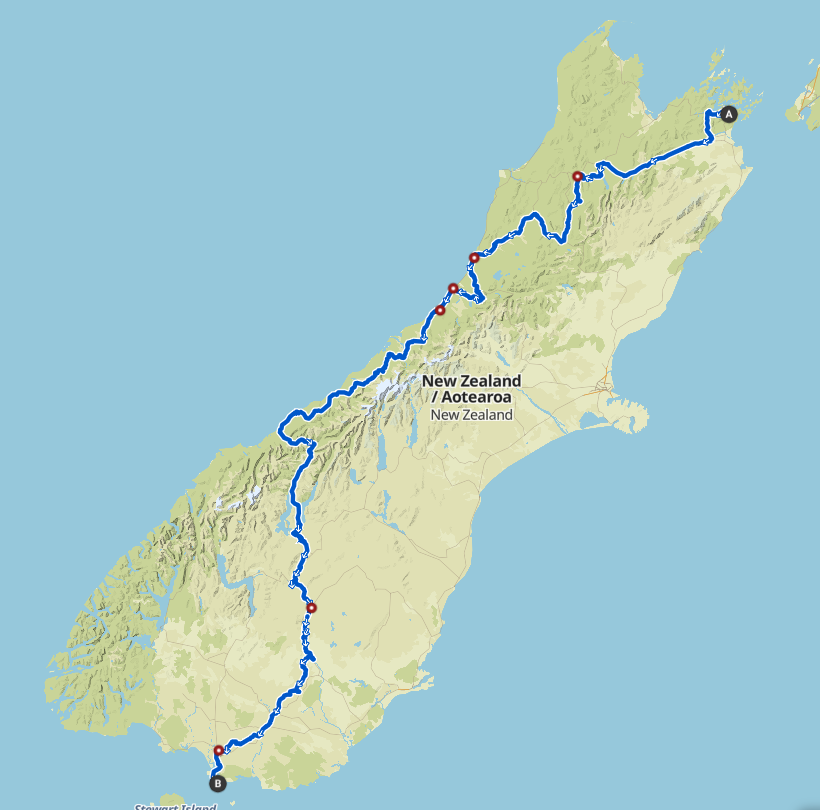
Day 50 | Invercargill to Bluff

We’re not Bluffing

Date: 19 March 2024

Our last day dawned chilly with clear blue skies and we set off from the Invercargill Holiday Park at the northern end of town at our usual 9:24 (you could set your watch by it – no matter what, we nearly always hit the road at 9:24). We skirted the city via a series of parks, and a shared path down the Waihopai River, to the industrial area where we had classic Southland cheese rolls at the very good Industry Cafe. Then it was cycleway all the way to Bluff – estuaries full of birds, acres of saltmarsh, and shimmering reflections on the glistening, still water of Bluff harbour, which we suspect doesn’t happen often. Even the sewage treatment plant looked attractive.

We arrived at Stirling Point to cheers from another couple who had just arrived, also having done a modified TA, and then we all cheered the next arrivals – three young, genuine, dot-carrying brevet riders. A bit of wine and beer may have been consumed by all.

We had a bit of momentum left after 3100 km so we dropped our bags at the Captain’s Cabin, and with featherweight bikes (and battery assistance) we shot up the steepest gradient of the whole trip to the summit of Bluff Hill, where, With today’s clear sky, we had a stupendous 360° view of all of Southland and Stewart Island to the south.

Over an appropriately Southern meal of Bluff oysters, Blue Cod and chips served in paper at Stella’s, the conversation quietly changed from “well done us” to “what’s next?” I can’t wait to find out.

Supplies: Bluff 4 Square

Accommodation: Captains Cabin, Bluff

These videos are best viewed on a computer screen. Turning your phone sideways helps.


This map shows 70km, whereas it was really 50 km. Something strange going on here.
Total distance: 75.37 km
Max elevation: 262 m
Min elevation: -2 m
Total climbing: 673 m
Total descent: -675 m
Total time: 06:35:54

Battery use: 48% : 300Wh


[subscribe2]


Day 49 | Mataura to Invercargill

Cold, wet milestones

Date: 19 March 2024

There was nothing much to see on what, on a fine day, would be a pleasant quiet back-road route, so we celebrated the twin milestones – our first rainy day, and passing the 3,000 km mark – by scoffing luke-warm Jimmy’s Pies in the shelter of a pine tree hedge. The carrot of a hot cup of tea propelled us on last leg, which was a long straight slog into our old friend the sou’wester.

A note of caution when stocking up in Invercargill – it’s one of those archaic monopolistic Trust areas where alcohol sales are restricted to far-distant bottle stores. Bloody uncivilized practice.

Supplies: Mataura and Invercargill
only

Accommodation: Invercargill Holiday Park

These videos are best viewed on a computer screen. Turning your phone sideways helps.


Total distance: 52.8 km
Max elevation: 148 m
Min elevation: 7 m
Total climbing: 458 m
Total descent: -499 m
Total time: 03:49:12

Battery use: 82% | 512Wh


[subscribe2]


Day 48 | Tapanui to Mataura

Mataura has a waterfall, and precious little else

Date: 17 March 2024

if you find yourself travelling south by car, bike, or even motorhome, today’s route is a great way to avoid the main roads. We didn’t take photos because it was damp – not raining but close – and we had a friendly southwesterly straight from the Antarctic blowing in our face all day, but it’s a lovely route with views and history you won’t find on the main roads. SH1 between Clinton and Gore is named the Presidential Highway, a dad joke from the 80s, no more amusing now than then, and we crossed it while deviating for a warming cuppa in Gore, to fuel the battle on to Mataura.

Poor unfortunate Mataura. In the 19th century it boasted a paperworks, dairy factory and freezing works and the falls in the middle of town were beginning to become quite a tourist attraction, but they were dynamited to provide more water for the local industry.

It’s worth making the effort to walk up the other side of the river from where, with a bit of trespassing, you get a view of the river and rapids emerging from under derelict warehouses like a scene from a Mad Max movie.

More recently the town became infamous for having vast amounts of toxic waste from the Bluff Aluminium Smelter stored in the now-defunct paper mill, right on the flood-prone river. (Now removed).

Check out the photo – this could/should be a tourist attraction in an otherwise dying town.

To paraphrase Flann O’Brien’s Third Policeman; as we went upon our way I was slightly glad that I’d been there.

Supplies: Mataura 4 Square

Accommodation: Mataura Falls Hotel

These videos are best viewed on a computer screen. Turning your phone sideways helps.


Total distance: 58.53 km
Max elevation: 234 m
Min elevation: 51 m
Total climbing: 705 m
Total descent: -834 m
Total time: 04:36:02

Battery use: 89% | 560Wh


[subscribe2]


Day 47 | Miller’s Flat to Tapanui

You call that flat??

Date: 16 March 2024

From Miller’s Flat we crossed the Clutha to backtrack to Ettrick, where we turned onto the misleadingly named Moa Flat Road. It begins with a stiff 400 m climb, and Moa Flat itself is quite lumpy, but we were more focused on the snow falling on a nearby range, giving a distinct crispness to the air. Down the other side we passed through Heriot, once thriving, now a ghost town, and Kelso, another once-busy town, now completely gone, having been abandoned following a 100-year-flood in 1978 and another even worse in 1980. The site is now noted only by some signs at the side of the road showing the flood height – well above head-level, in a very wide flat valley.

We thought we were on our own taking this route, but at Tapanui we met a guy who’d been ahead of us – also on an ebike, with two batteries and 40 kg of luggage! (He had camping gear).

We had just settled into our motel room at the pub when a knock on the door revealed another mad keen cyclist who had spotted our steeds. Paul Jesson was a Tour de France rider for one season in the late 70’s before a serious accident left him with one leg, but he went on to a very successful career as a paraplegic rider and became a great advocate for sport for the disabled. He now runs the Whitechapel Gift shop in the oldest church in Tapanui. This biking lark sure shakes out some dead-interesting trivia.

Supplies: Tapanui 4 Square
Accommodation: Forest Lodge Hotel, Tapanui

These videos are best viewed on a computer screen. Turning your phone sideways helps.


Total distance: 53.32 km
Max elevation: 519 m
Min elevation: 70 m
Total climbing: 976 m
Total descent: -868 m
Total time: 03:24:53

Battery use: 73% | 455Wh


[subscribe2]


Day 46 | Alexandra to Miller’s Flat

Roxburgh Gorge & Clutha Gold Trails

Date: 15 March 2024
Grade: 2, 3

These trails are among my favourite great rides in New Zealand – thank you John K. The Roxburgh Gorge is accessible only via the trail, and for the middle 12 km, only by jet boat. We did the trail from each end last time, so the boat trip was a first, and it is definitely worth doing. Laurence, our driver, zig-zagged down the river showing us old gold workings and miners’ shelters – overhanging rocks with stacked-up schist walls and stone beds. Many more of these troglodyte dwellings are sadly now under water, thanks to the dam downriver.

With fresh snow on the hills above us and a freezing headwind in our faces, the thought of spending winter here chasing a hopeful fortune did not appeal.

Back on our wheels at Shingle Creek; a few nice switchback climbs and drops to finish this trail, then we crossed the Roxburgh Dam to the start of the Clutha Gold Trail, which has a much gentler mood.

We stopped at Cafe 103 in Roxburgh for an Allpress coffee and lunch, thereby avoiding a couple of showers, then carried on down the river another 20 km to a very well equipped ‘basic’ cabin at the excellent Miller’s Flat Holiday Park.

Supplies: Roxburgh

Accommodation: Miller’s Flat Holiday Park

These videos are best viewed on a computer screen. Turning your phone sideways helps.


Total distance: 77.06 km
Max elevation: 249 m
Min elevation: 71 m
Total climbing: 1084 m
Total descent: -1235 m
Total time: 07:35:33

Battery use: 93% | 580Wh My back tyre had been softening and was much flatter than I thought, creating quite a lot of drag.


[subscribe2]


Day 45 | Cromwell to Alexandra

The Dunstan Trail

Date: 12 March 2024
Grade 2,3

After a brief pilgrimage to Cromwell’s industrial area to pick up a couple of Sanga’s Pies, at Bannockburn we rejoined the Dunstan Trail, which we did last year in brilliant sunshine. Today it was lightly overcast so we didn’t linger, although it would be a crime not to stop frequently to appreciate the raw, brutal, and beautiful landscape close up. It’s certainly popular – there were about 15 bikes parked at Carrick Vineyard when we stopped for an excellent coffee with the best view ever, and Sounds2Sounds riders were going the other way on their seriously impressive ride.

It’s a great trail with a good surface – mostly grade 2 with just enough grade 3 (narrow blind corners around bluffs with nasty drops on the outside) to give a real sense of adventure. SH8, just across the water, was very busy, ha ha.

At Cold Stew Flat we just had to stop and eat our now cool Holy Smoke (steak and smoked cheese) pies and the judges decision is final. Sangas and Clocktower Cafe are equal first in all New Zealand and in a league of their own – we’ve tried them all.

We’re having a last couple of lay-days at Mark and Libby’s beautiful house near Alexandra, with fab views of the starkly clear but distant ranges (stop me if I’m going on too much about the light down here).

Supplies: No problems. Cromwell, Clyde and Alexander have everything.

These videos are best viewed on a computer screen. Turning your phone sideways helps.


Total distance: 52.2 km
Max elevation: 332 m
Min elevation: 147 m
Total climbing: 916 m
Total descent: -900 m
Total time: 05:16:21

Battery use: 71% | 445Wh


[subscribe2]